
Non-Surgical Enlarged Prostate Treatment has become a preferred option for many men who want lasting relief from urinary symptoms without undergoing major surgery. An enlarged prostate, also known as Benign Prostatic Hyperplasia (BPH), is one of the most common health conditions affecting men over the age of 50. As the prostate grows, it can press against the urethra, making urination difficult and affecting overall quality of life.
While medications and conventional surgeries have long been used to manage BPH, many patients now choose Prostatic Artery Embolization (PAE) because it is a minimally invasive procedure that offers excellent symptom relief with a faster recovery. Patients looking for BPH Embolization Delhi can benefit from this advanced treatment performed by experienced interventional radiologists.
In this comprehensive guide, you’ll learn everything about Non-Surgical Enlarged Prostate Treatment, including symptoms, causes, diagnosis, the PAE procedure, benefits, recovery, and why it has become a trusted alternative to surgery.
Table of Contents
ToggleWhat Is an Enlarged Prostate (BPH)?
The prostate is a walnut-sized gland located below the bladder and surrounding the urethra. As men age, the prostate naturally enlarges. This non-cancerous enlargement is called Benign Prostatic Hyperplasia (BPH).
When the enlarged gland compresses the urethra, urine flow becomes restricted, leading to uncomfortable urinary symptoms.
Many men ignore these symptoms initially, but delaying treatment can lead to bladder damage, urinary retention, infections, and kidney complications. Fortunately, Non-Surgical Enlarged Prostate Treatment offers an effective solution before complications develop.
Common Symptoms of Enlarged Prostate
- Frequent urination, especially at night
- Difficulty starting urination
- Weak urine stream
- Interrupted urine flow
- Feeling that the bladder isn’t completely empty
- Urgency to urinate
- Dribbling after urination
- Pain or burning while urinating (in some cases)
- Recurrent urinary tract infections
- Sudden inability to urinate (medical emergency)
If these symptoms persist, consult a specialist for timely diagnosis and treatment.
Causes and Diagnosis of Enlarged Prostate
Causes of Enlarged Prostate
Although the exact cause isn’t fully understood, several factors increase the risk:
- Age above 50 years
- Hormonal changes
- Family history
- Obesity
- Diabetes
- Lack of physical activity
- Heart disease
- High blood pressure
Lifestyle factors can worsen symptoms, but aging remains the primary reason behind BPH.
Diagnosis
Proper diagnosis helps determine the best Non-Surgical Enlarged Prostate Treatment for each patient.
Your doctor may recommend:
- Medical history evaluation
- Physical examination
- Digital Rectal Examination (DRE)
- PSA (Prostate-Specific Antigen) blood test
- Urine analysis
- Ultrasound of the prostate
- Uroflowmetry
- Post-void residual urine test
- MRI or CT scan (when required)
These tests help rule out prostate cancer, infections, or other urinary conditions.
Non-Surgical Enlarged Prostate Treatment with Prostatic Artery Embolization (PAE)
Among all modern treatment options, Prostatic Artery Embolization (PAE) has emerged as one of the safest and most effective minimally invasive procedures.
What Is Prostatic Artery Embolization (PAE)?
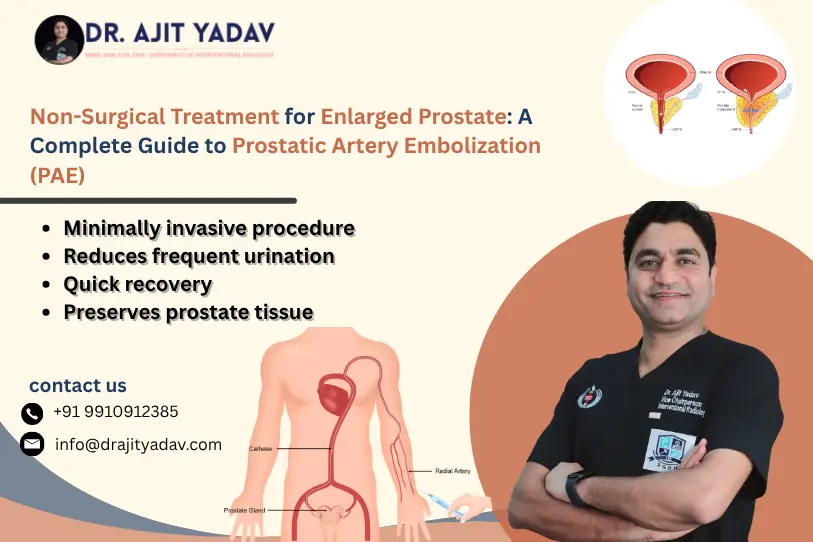
Prostatic Artery Embolization (PAE) is an image-guided procedure performed by an Interventional Radiologist. Instead of removing the prostate, tiny medical-grade particles are injected into the arteries supplying blood to the prostate.
This reduces blood flow, causing the enlarged prostate to gradually shrink over the following weeks and months, relieving pressure on the urethra.
Patients searching for BPH Embolization Delhi increasingly prefer PAE because it avoids major surgery and preserves normal anatomy.
How Is the Procedure Performed?
The Non-Surgical Enlarged Prostate Treatment process generally involves the following steps:
- Local anesthesia is administered.
- A tiny catheter is inserted through the wrist or groin artery.
- Advanced imaging guides the catheter to the prostate arteries.
- Tiny embolic particles block blood flow to the enlarged prostate.
- The prostate gradually shrinks.
- The catheter is removed without stitches.
The entire procedure usually takes 1–2 hours, and most patients return home the same day.
Who Is an Ideal Candidate?
You may benefit from Non-Surgical Enlarged Prostate Treatment if you:
- Have moderate to severe BPH symptoms
- Want to avoid surgery
- Are not responding to medications
- Have a large prostate
- Wish to preserve sexual function
- Have medical conditions that increase surgical risk
An Interventional Radiologist will determine your eligibility after imaging and evaluation.
Benefits, Recovery & Comparison with Surgery
Benefits of Non-Surgical Enlarged Prostate Treatment
Non-Surgical Enlarged Prostate Treatment offers several advantages over traditional surgical procedures:
- No major surgery
- No surgical cuts
- Local anesthesia instead of general anesthesia
- Same-day discharge in most cases
- Minimal pain
- Faster recovery
- Lower complication rates
- Reduced bleeding risk
- Preserves sexual function in most patients
- No hospital stay in many cases
- Effective long-term symptom relief
- Improves quality of life
Recovery After PAE
Recovery is generally smooth.
Most patients experience:
- Mild pelvic discomfort for a few days
- Temporary urinary frequency
- Return to light activities within 2–3 days
- Significant symptom improvement within weeks
- Continued prostate shrinkage over 3–6 months
Patients are advised to:
- Drink plenty of water
- Avoid heavy lifting for a few days
- Take prescribed medications
- Attend follow-up appointments
PAE vs Traditional Prostate Surgery
| Feature | Prostatic Artery Embolization (PAE) | Traditional Surgery |
| Incision | No | Yes |
| Hospital Stay | Usually Same Day | 2–5 Days |
| General Anesthesia | Usually No | Yes |
| Recovery | Faster | Longer |
| Blood Loss | Minimal | Higher |
| Sexual Function Risk | Lower | Higher |
| Catheter Duration | Short | Often Longer |
For many eligible patients, Non-Surgical Enlarged Prostate Treatment provides similar symptom relief with fewer risks.
About Dr. Ajit Yadav
Dr. Ajit Yadav is an experienced Interventional Radiologist specializing in advanced image-guided minimally invasive procedures. He focuses on providing effective treatments that help patients recover faster while avoiding unnecessary surgery.
With expertise in vascular and non-vascular interventions, Dr. Ajit Yadav offers personalized treatment plans using the latest technology and evidence-based medical practices.
Services Offered
- Prostatic Artery Embolization (PAE) for enlarged prostate
- Uterine Fibroid Embolization (UFE)
- Varicocele Embolization
- Thyroid Nodule Ablation
- Liver Tumor Ablation
- Kidney Tumor Ablation
- Lung Tumor Ablation
- Varicose Vein Treatment
- Dialysis Access Procedures
- Peripheral Artery Disease Treatment
- Image-Guided Biopsy
- Pain Management Procedures
Patients seeking BPH Embolization Delhi can consult Dr. Ajit Yadav for comprehensive evaluation and minimally invasive prostate treatment.
Frequently Asked Questions (FAQs)
1. What is Prostatic Artery Embolization (PAE)?
It is a minimally invasive image-guided procedure that shrinks the enlarged prostate by reducing its blood supply without surgery.
2. Is PAE painful?
Most patients experience little discomfort because the procedure is performed under local anesthesia with mild sedation.
3. How long does the procedure take?
Typically, Prostatic Artery Embolization (PAE) takes between 1 and 2 hours.
4. How soon will I notice improvement?
Many patients begin noticing improvement within a few weeks, with continued benefits over several months.
5. Is hospitalization required?
Most patients undergoing Non-Surgical Enlarged Prostate Treatment return home the same day.
6. Can PAE treat very large prostates?
Yes. PAE is often an excellent option for men with larger prostates who may not be ideal surgical candidates.
7. Will PAE affect sexual function?
Most studies show a low risk of erectile dysfunction, making it an attractive alternative to surgery.
8. Is PAE a permanent solution?
The procedure provides long-lasting symptom relief for many patients, although follow-up is important.
9. Who should avoid PAE?
Patients with certain vascular conditions or untreated prostate cancer may require alternative treatments after specialist evaluation.
10. Where can I get BPH Embolization Delhi?
Patients looking for BPH Embolization Delhi should consult an experienced Interventional Radiologist like Dr. Ajit Yadav for detailed assessment and personalized treatment planning
Conclusion
An enlarged prostate can significantly affect daily life, but modern medicine now offers highly effective alternatives to conventional surgery. Non-Surgical Enlarged Prostate Treatment with Prostatic Artery Embolization (PAE) provides long-lasting symptom relief through a minimally invasive approach, allowing patients to recover faster with fewer complications.
If you are experiencing persistent urinary symptoms, early evaluation is essential. Timely diagnosis and the right treatment can improve bladder function, restore comfort, and enhance your quality of life. For eligible patients, Non-Surgical Enlarged Prostate Treatment offers a safe, effective, and surgery-free solution.
Book an Appointment with Dr. Ajit Yadav
If you’re looking for expert Non-Surgical Enlarged Prostate Treatment or BPH Embolization Delhi, schedule a consultation with Dr. Ajit Yadav, an experienced Interventional Radiologist specializing in advanced minimally invasive procedures.
Get a comprehensive evaluation, personalized treatment plan, and expert care to relieve enlarged prostate symptoms—without major surgery. Book your appointment today and take the first step toward better urinary health.

Comments are closed