
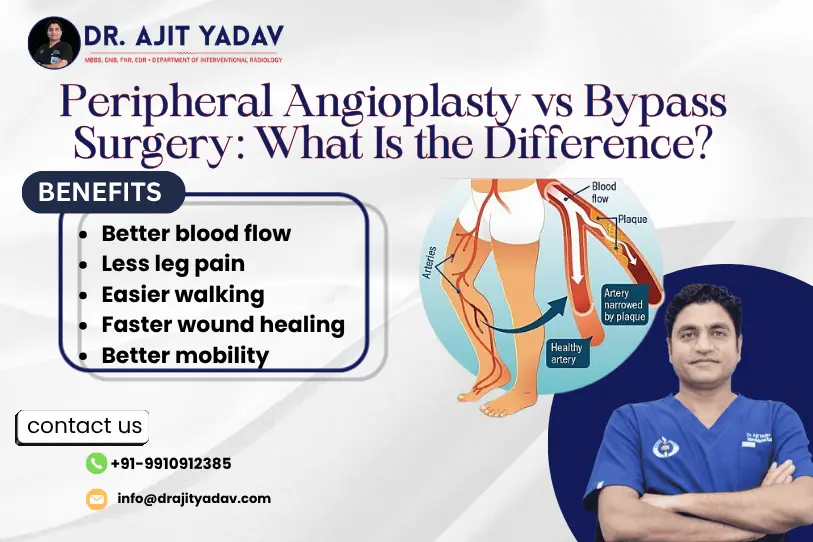
Peripheral artery disease (PAD) occurs when arteries that carry blood to the legs become narrowed or blocked, most commonly because of atherosclerosis. Reduced blood flow can cause leg pain while walking, weakness, slow-healing wounds, and, in advanced cases, tissue loss. Early diagnosis and appropriate treatment are important because severe PAD can increase the risk of limb-threatening complications and cardiovascular events.
When lifestyle measures, medicines, and structured exercise do not adequately control symptoms—or when blood flow is severely compromised—revascularization may be considered. Two important approaches are Peripheral Angioplasty and bypass surgery. Although both aim to improve blood flow, they differ considerably in how they are performed, their suitability for different blockages, recovery, and procedural risks.
This guide explains the difference between these treatments and the role they can play among PAD Treatment Options, while also clarifying why treatment should be individualized for every patient.
Understanding PAD: Symptoms, Causes and Diagnosis
What is Peripheral Artery Disease?
Peripheral artery disease is a circulation disorder in which narrowed or blocked arteries reduce blood flow, particularly to the legs and feet. Atherosclerosis—the buildup of plaque inside artery walls—is the most common cause. PAD may be asymptomatic, cause walking-related symptoms, or progress to chronic limb-threatening ischemia in severe cases.
Symptoms of PAD
Common symptoms include:
- Pain, cramping, or aching in the calf, thigh, hip, or buttock while walking
- Leg fatigue or weakness
- Pain that improves after resting
- Numbness or tingling in the legs or feet
- Coldness in one foot compared with the other
- Changes in skin color or appearance
- Slow-healing wounds on the feet or legs
- Reduced walking distance
- Pain in the foot or leg even at rest in advanced disease
Walking-related discomfort, known as claudication, is an important warning sign and should not simply be attributed to aging or joint problems.
Causes and Risk Factors
PAD is usually associated with atherosclerosis and shares many risk factors with other cardiovascular diseases. Important risk factors include smoking, diabetes, high blood pressure, high cholesterol, chronic kidney disease, increasing age, and a history of cardiovascular disease.
Diagnosis of PAD
Diagnosis generally begins with a medical history and physical examination. The ankle-brachial index (ABI), which compares blood pressure in the ankle and arm, is commonly used to detect PAD. Depending on the clinical situation, doctors may recommend Doppler ultrasound, CT angiography, MR angiography, or catheter-based angiography to understand the location and severity of arterial narrowing.
Before selecting Peripheral Angioplasty or bypass surgery, the doctor considers the location, length, and severity of the blockage, symptoms, limb condition, overall health, and expected procedural risk.
Peripheral Angioplasty: Procedure, Benefits and Recovery
What Is Peripheral Angioplasty?
Peripheral Angioplasty is a minimally invasive endovascular procedure designed to improve blood flow through a narrowed or blocked artery. A thin catheter is guided through the vascular system to the affected artery. A small balloon can then be inflated at the narrowed area to improve the channel through which blood flows. In selected cases, a stent may be placed to help maintain vessel patency.
The procedure does not require the surgeon to create a new route around the blockage. Instead, it works from inside the artery.
How Is Peripheral Angioplasty Performed?
The general process may involve:
- Reviewing vascular imaging and identifying the target blockage.
- Giving appropriate local anesthesia and other medication as required.
- Introducing a catheter through a small vascular access site.
- Guiding the catheter to the narrowed artery using imaging.
- Inflating a balloon to widen the narrowed segment.
- Placing a stent when clinically appropriate.
- Confirming improved blood flow before removing the catheter.
The exact technique depends on the patient’s anatomy and the characteristics of the arterial disease.
Benefits of Peripheral Angioplasty
Potential advantages include:
- Minimally invasive treatment
- Small access site rather than a large surgical incision
- Generally shorter recovery than open bypass surgery
- Ability to treat selected arterial blockages without open surgery
- Potential improvement in walking-related symptoms and limb blood flow
However, Peripheral Angioplasty is not automatically the best treatment for every patient. Long, complex, heavily calcified, or anatomically difficult blockages may require another revascularization strategy.
Recovery After Peripheral Angioplasty
Recovery depends on the access site, procedure performed, underlying health, and complexity of the arterial disease. Some patients can return to routine activities relatively quickly, while others need additional monitoring and a gradual return to physical activity.
Long-term care remains important. Treatment of PAD does not end with restoring blood flow. Guideline-directed medical therapy, exercise, smoking cessation, diabetes management, cholesterol control, blood-pressure management, and foot care remain important components of ongoing PAD management.
Bypass Surgery vs Peripheral Angioplasty: Comparison, Treatment and Recovery
What Is Bypass Surgery?
Bypass surgery creates an alternative pathway around a blocked section of an artery. A healthy vein—when suitable—or another graft material may be used to redirect blood around the obstruction. Bypass can be particularly useful when a long arterial segment is blocked or when anatomy makes an endovascular approach less suitable.
Unlike Peripheral Angioplasty, bypass surgery involves an operative procedure and generally requires a longer recovery period.
Peripheral Angioplasty vs Bypass Surgery
| Feature | Peripheral Angioplasty | Bypass Surgery |
| Approach | Endovascular/minimally invasive | Open surgical |
| Main principle | Opens the narrowed artery | Creates a new route around blockage |
| Incision | Usually a small access site | Larger surgical incision |
| Suitable for | Many selected focal or suitable arterial lesions | Selected long, complex, or surgically favorable blockages |
| Recovery | Generally shorter | Usually longer |
| Anesthesia | Depends on procedure and patient | Often requires more extensive anesthesia |
| Hospital stay | Often shorter | Usually longer |
| Decision factors | Anatomy, lesion characteristics, symptoms and risk | Anatomy, available conduit, surgical risk and expected benefit |
The choice should not be made simply by asking which procedure is “better.” The appropriate strategy depends on the patient’s arterial anatomy, symptoms, limb status, medical conditions, procedural risks, and personal goals. Current guidelines emphasize shared decision-making and consideration of both endovascular and surgical approaches when revascularization is indicated.
When May Peripheral Angioplasty Be Preferred?
Peripheral Angioplasty may be considered when the arterial anatomy is suitable for an endovascular approach and the expected benefits outweigh the risks. It can be particularly attractive when avoiding major surgery is desirable.
For patients with functionally limiting claudication that has not improved adequately with medical therapy and structured exercise, revascularization may be considered. In patients with chronic limb-threatening ischemia, revascularization is important for limb preservation when appropriate.
When May Bypass Surgery Be Considered?
Bypass may be considered when a long arterial segment is significantly blocked, when anatomy makes an endovascular approach less appropriate, or when surgical revascularization is expected to provide a better result for a particular patient.
For some femoropopliteal disease, current guidelines state that surgical revascularization can be reasonable when perioperative risk is acceptable and technical factors favor surgery, while endovascular revascularization is also an effective option in appropriate cases.
Benefits and Recovery
The goal of either treatment is to improve blood flow. Depending on the patient’s condition, successful revascularization may help improve walking ability, relieve ischemic symptoms, support wound healing, preserve limb function, and reduce the risk of limb loss in severe disease.
Recovery following bypass surgery generally takes longer because it involves open surgery. Recovery after Peripheral Angioplasty is typically less demanding, although individual recovery varies.
Importantly, neither procedure eliminates the underlying tendency toward vascular disease. Continued medical management and lifestyle changes are essential to reduce the risk of future vascular problems.
Frequently Asked Questions
1. Is Peripheral Angioplasty better than bypass surgery?
Not necessarily. Peripheral Angioplasty may be appropriate for some arterial blockages, while bypass may be preferable for selected complex or extensive disease. The decision depends on anatomy, symptoms, medical condition, and procedural risk.
2. Is Peripheral Angioplasty a major surgery?
No. It is an endovascular procedure performed through a small vascular access site rather than through an open surgical incision. However, it remains a medical procedure with potential risks and should be performed after appropriate evaluation.
3. How long does Peripheral Angioplasty take?
The duration varies according to the number, location, and complexity of the blockages and whether additional techniques such as stent placement are required.
4. Does every PAD patient need angioplasty or bypass?
No. Many patients initially require risk-factor management, medications, structured exercise, and lifestyle changes rather than revascularization. Revascularization is considered when symptoms remain limiting despite appropriate treatment or when limb-threatening ischemia is present.
5. Can PAD be treated without surgery?
Yes. Treatment can include medical therapy, structured exercise, risk-factor modification, and, when appropriate, minimally invasive endovascular procedures such as angioplasty. The appropriate PAD Treatment Options depend on disease severity and individual circumstances.
6. What happens if PAD is left untreated?
Progressive PAD can lead to worsening walking limitations and, in severe cases, chronic limb-threatening ischemia, tissue loss, or amputation. PAD is also associated with increased cardiovascular risk.
7. Can angioplasty prevent amputation?
When severe PAD threatens the limb, restoring blood flow through an appropriate revascularization strategy can be an important part of limb preservation. However, outcomes depend on disease severity, tissue damage, infection, circulation, and other health factors.
8. Is bypass surgery always more effective for severe blockages?
Not always. For complex PAD, the choice between surgical bypass and endovascular treatment requires assessment of arterial anatomy, available conduit, surgical risk, comorbidities, and patient preferences.
9. Can someone walk normally after PAD treatment?
Many patients experience improved walking ability after successful treatment, particularly when revascularization is combined with structured exercise and appropriate medical management. Individual results vary.
10. Is varicocele treatment related to PAD treatment?
No. Varicocele treatment addresses enlarged veins around the testicle and is a different vascular condition from peripheral artery disease. Patients should not assume that a treatment for one condition applies to the other.
Conclusion: Choosing the Right PAD Treatment
Peripheral Angioplasty and bypass surgery are both established revascularization approaches, but they work differently and are suitable for different clinical situations. Angioplasty uses a catheter-based approach to improve blood flow through a narrowed artery, whereas bypass creates an alternative pathway around the blocked segment.
The right treatment should be based on detailed vascular imaging, symptoms, severity of disease, arterial anatomy, overall health, procedural risk, and the patient’s treatment goals. Modern PAD Treatment Options may also include medication, structured exercise, lifestyle modification, angioplasty, stenting, atherectomy, bypass surgery, or a combination of approaches when clinically indicated.
If you have persistent leg pain while walking, unexplained foot or leg symptoms, non-healing wounds, or have been diagnosed with PAD, timely evaluation can help determine whether conservative management or revascularization is appropriate.
Book an Appointment with Dr. Ajit Yadav
For expert evaluation of peripheral arterial disease and minimally invasive vascular treatment options, consult Dr. Ajit Yadav, Interventional Radiologist. His interventional radiology services focus on image-guided, minimally invasive approaches for vascular conditions, with treatment planned according to the patient’s individual anatomy and clinical needs.
If you have symptoms of PAD or have been advised to consider angioplasty or bypass surgery, book an appointment with Dr. Ajit Yadav to discuss your diagnosis, treatment options, and the most appropriate approach for restoring blood flow.

Comments are closed