
- info@drajityadav.com
- Department Of Interventional Radiology, Sir Ganga Ram Hospital, Delhi, 110060
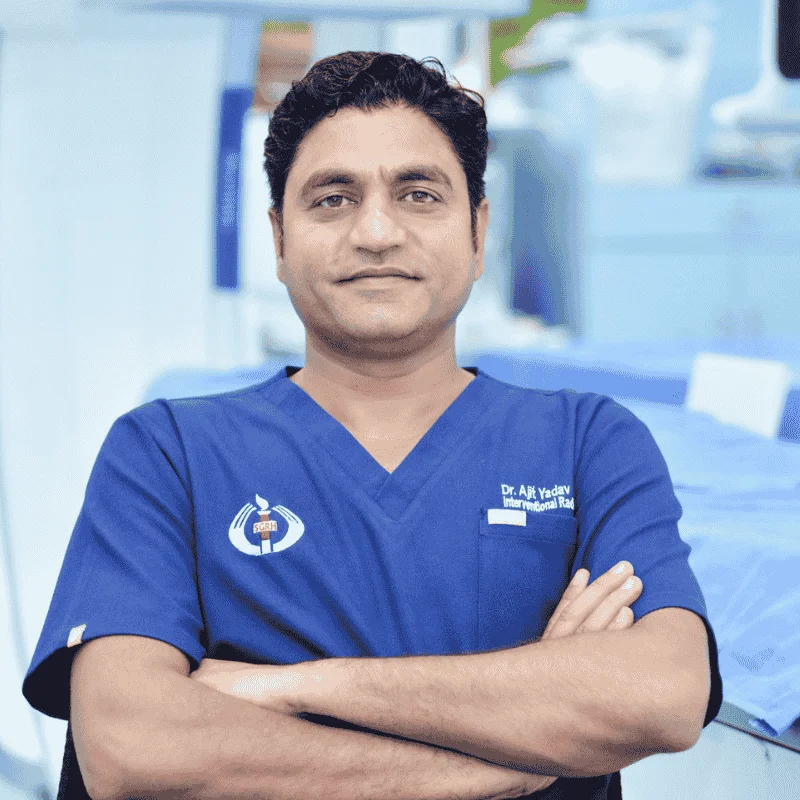
Non-surgical, image-guided varicocele care with Dr. Ajit Yadav, Senior Consultant, Department of Interventional Radiology, Sir Ganga Ram Hospital, Delhi.
Varicocele embolization treatment in Delhi is a minimally invasive option for men with enlarged scrotal veins who have pain, a heavy feeling or fertility concerns. Instead of cutting the scrotum or groin, an interventional radiologist closes the faulty vein from inside, using a thin catheter and X-ray guidance. Dr. Ajit Yadav first examines each patient and reviews the scans and semen reports. He then explains whether embolization, surgery or simple monitoring makes the most sense.
A varicocele is a cluster of dilated veins around the testicle, much like varicose veins in the leg. It is found in roughly 10 to 15 percent of men, and in about one in four men with an abnormal semen analysis. Most occur on the left side [1].
Faulty valves in the testicular vein let blood flow backwards and pool, which can cause aching, swelling and, in some men, poorer sperm quality.
Embolization blocks that refluxing vein. A catheter carries tiny metal coils, a vein-closing (sclerosing) agent, or both into the vein, and blood is then rerouted through healthy veins. Nothing is removed, and the testicle and its normal blood supply stay in place.
Many varicoceles cause no trouble and need no treatment. Treatment is usually discussed when a man has:
Major guidelines support repair mainly for men with a palpable varicocele, abnormal semen parameters and infertility. They do not recommend it for men with normal semen results or a varicocele seen only on ultrasound [2][3]. The guideline wording refers to surgical repair; embolization pursues the same goal by a different route.
The procedure often takes about 30 to 60 minutes, depending on the anatomy.
Benefits vary from person to person, and no result can be guaranteed.
| Option | How it works | Points in its favour | Limits to know |
|---|---|---|---|
| Observation | Regular check-ups and semen tests | No procedure; reasonable for painless varicoceles with normal semen | Does not treat pain or a fertility problem |
| Microsurgical varicocelectomy | Veins tied through a small incision under a microscope | Widely regarded as a reference-standard repair; highest pregnancy rates among the techniques compared in one network analysis [5] | Needs an incision and anaesthesia; usually a longer recovery; needs a microsurgery-trained surgeon |
| Open or laparoscopic surgery | Veins tied at a higher level | Familiar techniques | Higher recurrence and hydrocele rates than microsurgery in pooled data [6] |
| Embolization | Catheter closes the vein from inside | No incision; quick recovery | Not every vein can be reached; X-ray exposure; recurrence rates vary between studies |
A 2022 meta-analysis of 16 studies and 2,138 patients found similar recurrence and pregnancy rates for endovascular and surgical treatment, with fewer adverse events after endovascular treatment [7]. An older pooled analysis, however, reported higher recurrence after embolization, about 12.7 percent against about 1 percent for microsurgery [6]. Study designs differ, so the evidence is not settled.
The right option depends on the side affected, vein anatomy, fertility goals and the expertise available. A good consultation covers all of them.
Embolization may suit:
Another approach may be better when:
Common and usually minor: bruising or tenderness at the puncture site, and temporary soreness in the groin, flank or along the treated vein.
Less common: reaction to contrast dye, infection, injury to a vein, a coil moving from its intended position, and clotting in the veins around the testicle [8].
Treatment limits: the procedure can be completed successfully in about 90 percent of attempts [8]. In the rest, the vein may be too small or twisted to reach and another approach may be needed. A varicocele can also persist or return.
Radiation: the procedure uses X-ray fluoroscopy. A careful team keeps the dose as low as reasonably achievable and uses shielding, so ask how this is managed.
Contact your doctor promptly for fever, increasing scrotal pain or swelling, bleeding or a growing lump at the puncture site, leg swelling or breathlessness. No procedure is risk-free.
Most patients go home the same day and return to normal activities within 24 to 48 hours. Typical advice, to be confirmed by your doctor, is:
Discomfort often eases within weeks. If fertility was the goal, semen analysis is usually repeated about three months later, because sperm take roughly that long to develop.
Cost varies from patient to patient, so a fixed number online would be misleading. The main factors are:
Figures on third-party websites differ widely and rarely say what is included, so ask for an itemised written estimate after your consultation.
When comparing a varicocele embolization specialist in Delhi, look for:
Dr. Ajit Yadav (MBBS, DNB, FVIR, EBIR) is Senior Consultant in the Department of Interventional Radiology at Sir Ganga Ram Hospital, New Delhi. He completed his residency in radiodiagnosis at Sir Ganga Ram Hospital, followed by a fellowship in interventional radiology and a short fellowship at MD Anderson Cancer Center, Houston, in 2013. He has more than 30 peer-reviewed publications, teaches residents and fellows, and holds leadership roles in national interventional radiology societies, including the Indian Society of Vascular and Interventional Radiology (ISVIR).
Varicocele embolization sits alongside other image-guided treatments offered through the department, such as fibroid, prostate and liver procedures. Each patient receives an individual assessment and a plain explanation of the options, including when another treatment may suit them better.
A consultation usually includes a history, an examination while standing and a review of any scans and semen reports. Tests are advised if needed and the options are explained.
Bring: earlier ultrasound and semen reports, hormone tests, a list of medicines and allergies, details of any previous surgery and, if relevant, your partner's fertility assessment.
Questions worth asking: Do I need treatment? Which option suits me? What are the risks and realistic benefits? What will it cost?
Consultation hours are Monday to Saturday, 12:00 PM to 2:00 PM, and Sunday is closed. Call or WhatsApp +91 99109 12385 to book.
Varicocele embolization treatment is a minimally invasive procedure in which an interventional radiologist passes a thin catheter into the testicular vein through a small puncture and blocks it with coils, a sclerosing agent or both. Blood is then rerouted through healthy veins.
Most patients feel pressure rather than sharp pain because the puncture site is numbed with local anaesthetic, and mild sedation can be added. Soreness for a few days is common and usually eased with painkillers advised by your doctor.
Most patients go home the same day and return to normal activities within 24 to 48 hours. Heavy lifting, cycling and strenuous exercise are usually avoided for a period your doctor will specify.
Not always. A 2022 meta-analysis found similar recurrence and pregnancy rates with fewer adverse events after endovascular treatment, but older analyses reported higher recurrence than microsurgery. The better option depends on your anatomy, fertility goals and available expertise.
It can improve semen parameters in some men, and published reviews report fertility improvements after embolization. Results are not guaranteed, and benefit is most likely with a palpable varicocele and abnormal semen.
Cost depends on whether one or both sides are treated, the hospital category, tests, the embolic material, sedation, consultant fees and follow-up. Insurance cover varies by plan. Ask for a written, itemised estimate after your consultation, as no fixed figure can fairly be quoted without examining you.
Yes. A varicocele can persist or recur, particularly with side branches or unusual vein anatomy, and recurrence rates differ between studies. Options then include repeat embolization or surgery.
It is generally well tolerated, but risks include puncture-site bruising, temporary soreness, contrast dye reaction, infection, coil movement, vein injury, clotting around the testicle and X-ray exposure. The procedure cannot always be completed.
Often not. Treatment is usually considered for pain, a smaller testicle, or infertility with a palpable varicocele and abnormal semen results. Painless varicoceles with normal semen are usually monitored with periodic review.
If you are considering varicocele embolization treatment in Delhi, a consultation is the first step. Dr. Ajit Yadav will examine you, review your reports and explain every suitable option.
Dr. Ajit Yadav, Senior Consultant, Department of Interventional Radiology