
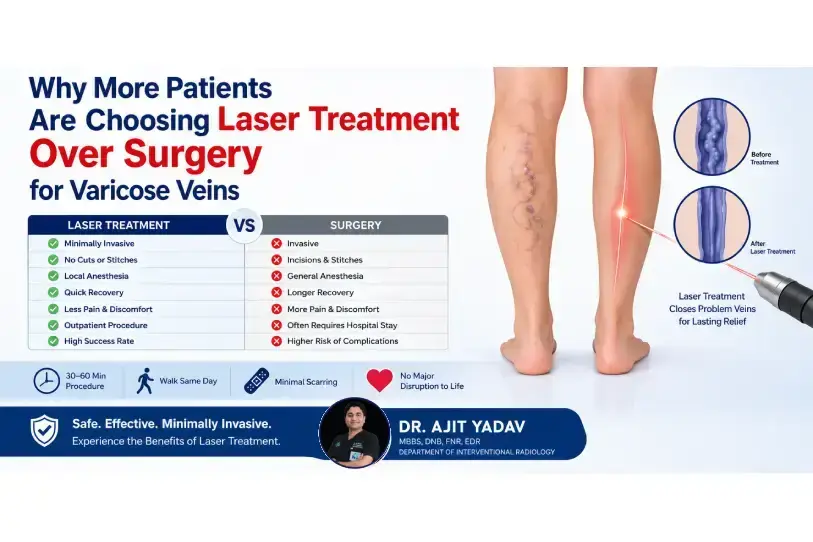
If you’ve been living with the discomfort, swelling, and unsightly appearance of varicose veins, you’re not alone. Millions of people across India suffer from this condition — and for years, surgical stripping was the only real solution. But times have changed. Today, Laser Treatment Over Surgery for Varicose Veins is not just available — it’s the preferred choice for a growing number of patients.
As a consultant Interventional Radiologist at Sir Ganga Ram Hospital, New Delhi, I’ve witnessed a dramatic shift in how patients approach varicose vein care. More and more are walking into my clinic asking specifically about laser treatment. In this blog, I want to explain why — and help you understand whether it could be the right choice for you.
Table of Contents
ToggleWhat Are Varicose Veins, and Why Do They Need Treatment?
Varicose veins are enlarged, twisted veins — most commonly seen in the legs — that occur when the valves inside the veins stop functioning properly. Instead of blood flowing efficiently back to the heart, it pools in the vein, causing it to bulge and become visible beneath the skin.
Left untreated, varicose veins can progress from a cosmetic concern to a genuine medical problem, causing:
- Persistent aching, heaviness, or throbbing in the legs
- Swelling around the ankles and calves
- Skin discolouration or hardening around the affected area
- Bleeding from damaged veins
- Venous ulcers — open sores that are difficult to heal
Treatment isn’t just about aesthetics. It’s about restoring quality of life and preventing serious complications. so Laser Treatment Over Surgery for Varicose Veins
The Old Way: Surgical Stripping
For decades, surgical stripping was the standard treatment. The procedure involved making incisions in the leg, tying off the affected vein, and physically pulling it out. While effective, it came with significant downsides:
- General anaesthesia was required, adding risk — especially for elderly patients or those with health conditions
- Long recovery times of 2–6 weeks were common
- Scarring from multiple incisions was unavoidable
- Post-operative pain and bruising were often significant
- Hospitalisation for 1–3 days was typically required
Many patients — particularly those with busy lives or underlying health concerns — either delayed treatment or avoided it altogether because of these factors.
The Modern Choice: Laser Treatment for Varicose Veins
Non-surgical varicose vein treatments, particularly Endovenous Laser Ablation (EVLA), have fundamentally changed the landscape. This minimally invasive procedure uses laser energy delivered through a thin fibre inserted into the vein to seal it shut — with no cuts, no stitches, and no hospital stay.
Here’s what makes it a game-changer:
1. No Surgery, No Scalpel
EVLA is performed under local anaesthesia. A small needle puncture is all that’s needed to access the vein. There are no incisions, no stitches, and no visible scarring. For patients anxious about going under the knife, this alone is transformative.
2. Walk In, Walk Out
One of the most valued benefits of non-surgical varicose veins treatment in Delhi is the minimal disruption to daily life. The procedure typically takes 45–60 minutes, and most patients walk out of the clinic the same day. Many return to work and normal activities within 24–48 hours.
3. Performed Under Local Anaesthesia
Because EVLA requires only local anaesthesia, it is safe for patients who may not be candidates for general anaesthesia — including elderly individuals, those with heart conditions, or patients on certain medications. The risks associated with general anaesthesia are eliminated entirely.
4. Highly Effective and Durable
Clinical studies consistently show that EVLA has success rates of over 95% at the 5-year mark — comparable to or better than traditional surgery. The treated vein is permanently closed and eventually absorbed by the body, with no risk of recurrence in that specific vessel.
5. Minimal Downtime and Faster Recovery
Post-procedure discomfort is significantly less than with surgery. Most patients report only mild soreness or bruising for a few days. Compression stockings are worn for a week or two, and light walking is actually encouraged from day one to aid circulation and healing.
6. No Hospitalisation Required
The entire procedure is done in an outpatient setting — no overnight hospital stay, no admission paperwork, no institutional recovery environment. This reduces cost, inconvenience, and exposure to hospital-acquired infections.
7. Excellent Cosmetic Outcomes
Because there are no incisions, the cosmetic result is far superior to surgery. The skin over the treated area heals cleanly, without surgical scars. For patients who are also concerned about the appearance of smaller surface veins, complementary procedures like foam sclerotherapy or microsclerotherapy can be performed during the same session.
What Does the Procedure Involve?
Here is a step-by-step overview of what patients can expect during EVLA:
- Ultrasound mapping — The veins are mapped using duplex ultrasound to plan the treatment precisely
- Local anaesthesia — Anaesthetic is injected around the vein using tumescent anaesthesia, which also protects surrounding tissue
- Laser fibre insertion — A thin laser fibre is passed into the vein through a small needle puncture
- Laser activation — As the fibre is slowly withdrawn, laser energy seals the vein wall from inside
- Compression — A compression bandage or stocking is applied immediately after
- Post-procedure check — A brief ultrasound confirms the vein is fully sealed before the patient leaves
The entire process is guided by real-time ultrasound imaging throughout — a key advantage of having the procedure performed by a trained Interventional Radiologist.
Who Is a Good Candidate for Non-Surgical Varicose Veins Treatment in Delhi?
Laser treatment is suitable for most patients with symptomatic varicose veins, including those who:
- Have great saphenous or small saphenous vein reflux confirmed on duplex ultrasound
- Are experiencing pain, swelling, or skin changes due to venous insufficiency
- Want to avoid the risks and recovery time of surgery
- Have previously tried and failed conservative treatments like compression stockings
- Have underlying health conditions that make general anaesthesia risky
A thorough consultation and ultrasound assessment will determine whether EVLA is appropriate for your specific anatomy and vein pattern.
Why Choose an Interventional Radiologist for This Procedure?
This is a question worth addressing directly. Interventional Radiologists are specialists in image-guided, minimally invasive procedures. The entire discipline is built around doing more with less — achieving the outcomes of surgery through tiny punctures, guided in real time by advanced imaging.
For varicose vein treatment, this expertise matters. Proper duplex ultrasound assessment before the procedure, real-time ultrasound guidance during laser fibre placement, and post-procedure imaging to confirm vein closure all require specific training and experience. In the wrong hands, even a “simple” laser procedure can lead to incomplete treatment, nerve damage, or skin burns.
When you choose a qualified Interventional Radiologist for your non-surgical varicose veins treatment in Delhi, you are choosing a physician whose entire speciality is built on this kind of precision.
A Note on Cost
One common question is whether laser treatment costs more than surgery. The answer depends on several factors — the number of veins being treated, whether additional procedures like foam sclerotherapy are needed, and the facility where treatment is performed.
However, when patients consider the total cost — including hospitalisation, anaesthesia fees, post-operative medication, time off work, and the longer recovery period — non-surgical treatment is often comparably priced or even more economical overall. We are happy to provide a detailed cost estimate following your initial consultation and ultrasound assessment.
Don’t Wait — Varicose Veins Won’t Improve on Their Own
This is perhaps the most important message of all. Varicose veins are a progressive condition. Without treatment, they tend to worsen over time, increasing the risk of skin changes, bleeding, superficial thrombophlebitis, and venous ulcers.
If you’ve been putting off treatment because you feared surgery, now is the time to reconsider. Non-surgical varicose veins treatment in Delhi has made effective care accessible, safe, and — for most patients — genuinely easy to fit into a normal life.
Consult Dr. Ajit K. Yadav
Dr. Ajit K. Yadav is one of Delhi’s leading Interventional Radiologists, practising as a consultant in the Department of Interventional Radiology at Sir Ganga Ram Hospital, New Delhi. With extensive experience in endovenous laser ablation, foam sclerotherapy, and other minimally invasive vascular procedures, Dr. Yadav offers comprehensive, personalised care for patients with varicose veins and venous insufficiency.
To schedule a consultation or learn more about non-surgical varicose veins treatment in Delhi, please get in touch with Sir Ganga Ram Hospital’s Interventional Radiology Department.
This blog is intended for informational purposes only and does not constitute medical advice. Please consult a qualified medical professional for diagnosis and personalised treatment recommendations.

Comments are closed