
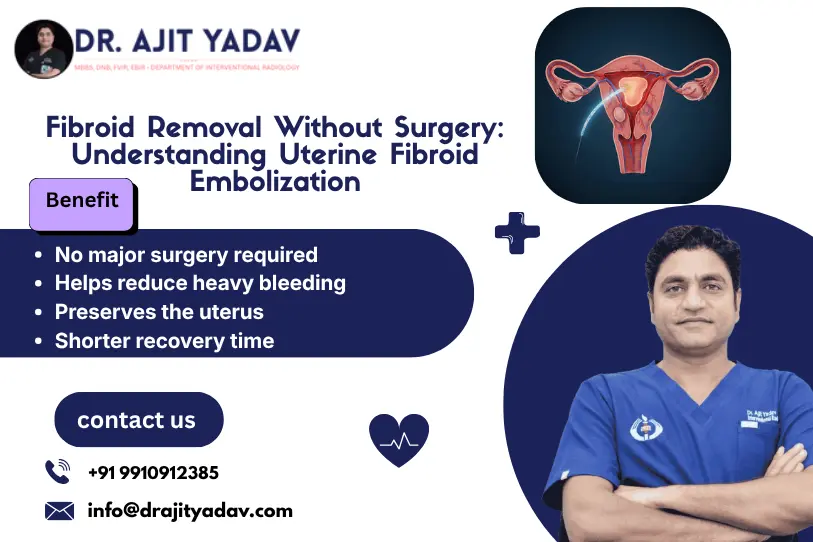
Uterine fibroids are non-cancerous growths that develop in or around the uterus. They are common during the reproductive years and may cause heavy menstrual bleeding, pelvic pressure, abdominal discomfort, frequent urination, or fertility-related concerns. While some fibroids do not require treatment, symptomatic fibroids may need medical evaluation and an appropriate treatment plan.
Fibroid Removal Without Surgery: Understanding Uterine Fibroid Embolization introduces a minimally invasive treatment option for selected patients who want to manage uterine fibroids without conventional open surgery. Uterine Fibroid Embolization (UFE), also called uterine artery embolization for fibroids, reduces the blood supply to fibroids, causing them to shrink over time.
For patients exploring fibroid treatment in Delhi, understanding the available options, procedure, benefits, recovery, and limitations can help them make informed decisions. Dr. Ajit Yadav can help patients understand whether an interventional radiology approach is suitable for their individual condition.
What Are Uterine Fibroids? Symptoms, Causes and Diagnosis
Uterine fibroids, medically known as leiomyomas, are usually benign growths made up of muscle and connective tissue. They vary in size, number, and location. Some remain small and cause no symptoms, while others can affect daily activities and quality of life.
Common symptoms of uterine fibroids
The symptoms depend on the fibroids’ size, number, and position within the uterus. Common symptoms include:
- Heavy or prolonged menstrual bleeding.
- Painful menstrual periods or pelvic cramps.
- Pelvic pressure, heaviness, or persistent discomfort.
- Frequent urination due to pressure on the bladder.
- Constipation or difficulty passing stools when nearby structures are compressed.
- Lower back pain or discomfort in the lower abdomen.
- Abdominal enlargement or bloating.
- Fatigue or weakness associated with iron-deficiency anemia from heavy bleeding.
Some women experience no symptoms and discover fibroids during a routine gynaecological examination or ultrasound.
What causes uterine fibroids?
The exact cause of fibroids is not fully understood. However, several factors may contribute to their development and growth:
- Hormones: Oestrogen and progesterone influence fibroid growth.
- Genetics: A family history of uterine fibroids may increase the likelihood of developing them.
- Age and reproductive factors: Fibroids are commonly diagnosed during the reproductive years.
- Individual biological factors: Growth patterns vary between patients and cannot always be predicted.
Having fibroids does not automatically mean that treatment is necessary. The decision depends on symptoms, fibroid characteristics, medical history, reproductive plans, and the patient’s preferences.
How are uterine fibroids diagnosed?
A healthcare professional may recommend one or more of the following investigations:
- Medical history and examination: To understand symptoms, menstrual patterns, and relevant health conditions.
- Pelvic ultrasound: To assess the size, number, and location of fibroids.
- MRI: In selected cases, to provide more detailed information about fibroid anatomy and blood supply.
- Blood tests: A complete blood count and iron studies may be recommended if heavy bleeding is suspected to have caused anaemia.
- Additional investigations: Depending on age, bleeding patterns, and other risk factors, further evaluation may be needed to rule out alternative causes of symptoms.
An accurate diagnosis helps determine whether observation, medication, UFE, myomectomy, or another treatment is appropriate.
How Does Uterine Fibroid Embolization Work?
Uterine Fibroid Embolization (UFE) is a minimally invasive procedure performed by an interventional radiologist. Instead of surgically removing individual fibroids, the procedure reduces their blood supply, allowing them to shrink gradually.
For patients researching Fibroid Removal Without Surgery: Understanding Uterine Fibroid Embolization, it is important to know that UFE is not the same as radiofrequency ablation (RFA). UFE blocks blood flow to fibroids, whereas RFA uses heat to destroy fibroid tissue. The appropriate treatment depends on the patient’s diagnosis and clinical needs.
What happens during the UFE procedure?
The procedure generally involves the following steps:
- Pre-procedure assessment: The medical team reviews symptoms, imaging results, medical history, medications, and relevant blood tests.
- Preparation and anaesthesia: The patient receives appropriate pain control and sedation or anaesthesia, depending on the clinical plan.
- Catheter insertion: The interventional radiologist inserts a thin catheter through a small puncture, usually in an artery in the wrist or groin.
- Blood vessel imaging: Imaging guidance helps the specialist identify the arteries supplying the uterus and fibroids.
- Embolization: Tiny medical particles are released into the targeted arteries to reduce the blood supply feeding the fibroids.
- Post-procedure monitoring: The catheter is removed, the puncture site is managed, and the patient is observed before discharge or further hospital care as needed.
Over the following weeks and months, the treated fibroids generally shrink, and symptoms may improve. The extent of improvement varies from patient to patient.
Who may be suitable for UFE?
UFE may be considered for patients who:
- Experience heavy menstrual bleeding or persistent pelvic pressure due to fibroids.
- Have fibroids confirmed through appropriate imaging.
- Prefer a minimally invasive alternative to conventional surgery.
- Want to preserve their uterus.
- Are medically suitable for an embolization procedure.
However, UFE is not suitable for everyone. Patients with suspected pregnancy, active pelvic infection, certain fibroid characteristics, or other relevant medical conditions require careful assessment. Women planning a future pregnancy should discuss fertility goals and alternative treatments with their gynaecologist because the effects of UFE on future pregnancy are not fully predictable.
Benefits, Recovery and Comparison With Surgery
One reason patients explore Fibroid Removal Without Surgery: Understanding Uterine Fibroid Embolization is that UFE can treat symptomatic fibroids without a large surgical incision.
Potential benefits of UFE
The potential benefits include:
- Minimally invasive treatment: The procedure uses a small arterial puncture rather than a large abdominal incision.
- Uterus preservation: The uterus remains in place.
- Symptom relief: Many patients experience improvement in heavy bleeding, pelvic pressure, and related symptoms.
- Shorter recovery: Recovery is often quicker than after major abdominal surgery.
- Treatment of multiple fibroids: Several fibroids may be treated during the same procedure.
- Reduced need for conventional surgery: UFE may offer an alternative to myomectomy or hysterectomy for appropriately selected patients.
These benefits are not guaranteed. Some patients may experience persistent symptoms, incomplete fibroid shrinkage, or recurrence of symptoms requiring further treatment.
What is recovery like after UFE?
Recovery varies according to individual health, fibroid characteristics, and the body’s response to treatment. Many patients return home the same day or after an overnight stay, depending on their clinical circumstances.
Common short-term effects include:
- Pelvic cramps or pain.
- Tiredness and nausea.
- Mild fever or flu-like symptoms for a short period.
- Vaginal discharge or changes in menstrual bleeding.
These symptoms are generally managed with prescribed medication and post-procedure instructions. Most patients gradually resume routine activities within days to approximately one or two weeks, although complete recovery and symptom improvement can take longer.
Patients should follow their treating team’s guidance regarding physical activity, wound care, medication, and follow-up appointments. Severe or worsening pain, persistent high fever, heavy bleeding, or foul-smelling discharge warrants prompt medical assessment.
UFE versus myomectomy and hysterectomy
When considering Fibroid Removal Without Surgery: Understanding Uterine Fibroid Embolization, patients should compare UFE with other established treatments rather than assuming one option is best for everyone.
| Factor | UFE | Myomectomy | Hysterectomy |
| Approach | Minimally invasive embolization | Surgical removal of fibroids | Surgical removal of the uterus |
| Uterus preserved | Yes | Yes | No |
| Treats multiple fibroids | Often | Depending on number and location | Removes the uterus |
| Recovery | Usually shorter than major surgery | Varies by surgical approach | Varies by surgical approach |
| Future pregnancy | Possible, but requires careful counselling | May be considered depending on circumstances | Not possible after uterus removal |
| Main consideration | Fibroids shrink over time; further treatment may be needed | Fibroids may recur | Definitive treatment for uterine fibroids |
Medication and observation may also be appropriate for some patients. The choice should be made after considering symptom severity, fibroid location and size, age, overall health, reproductive plans, and personal preferences.
Treatment costs also vary. They depend on the hospital, investigations, procedure requirements, length of stay, medications, and insurance coverage. An individual estimate should be obtained after clinical evaluation rather than relying on a general advertised price.
Frequently Asked Questions About Fibroid Removal Without Surgery
1. Can uterine fibroids be treated without surgery?
Yes. Uterine Fibroid Embolization is a minimally invasive option for selected patients. Medication and monitoring may also be appropriate, depending on symptoms and fibroid characteristics.
2. Is UFE a safe procedure?
UFE is an established treatment, but, like any medical procedure, it carries risks. These may include infection, bleeding, contrast-related complications, damage to nearby tissues, and, rarely, the need for additional intervention. A specialist should explain the risks relevant to each patient.
3. How long does a UFE take to work?
Some symptoms may improve within weeks, while fibroid shrinkage generally occurs over several months. The timeline varies depending on the individual response and the characteristics of the fibroids.
4. Can fibroids return after UFE?
Treated fibroids usually shrink, but symptoms can persist or return. New fibroids may develop, and some patients may require additional treatment in the future.
5. Can I become pregnant after UFE?
Pregnancy may be possible after UFE, but its effects on fertility and pregnancy outcomes require careful discussion. Patients who wish to conceive should consult their gynaecologist about the relative benefits and risks of UFE and myomectomy before deciding.
6. Is UFE better than myomectomy?
Neither procedure is universally better. UFE avoids surgical removal of fibroids, while myomectomy removes them directly. The preferred option depends on fibroid anatomy, symptoms, medical history, and pregnancy plans.
7. Does UFE require a hospital stay?
Some patients are discharged on the same day, while others require an overnight stay for pain management or observation. The treating team determines the appropriate arrangement.
8. How much does fibroid embolization cost in Delhi?
The cost varies according to hospital charges, investigations, clinical complexity, medications, and the patient’s length of stay. Contact the hospital for an individual estimate after assessment.
9. Where can I consult a specialist for UFE in Delhi?
Patients can enquire about evaluation and treatment options with Dr. Ajit Yadav at Sir Ganga Ram Hospital, Old Rajinder Nagar, Rajinder Nagar, Delhi, 110060. Availability of UFE and the suitability of treatment should be confirmed directly with the hospital.
Conclusion: Explore Your Fibroid Treatment Options
Fibroid Removal Without Surgery: Understanding Uterine Fibroid Embolization highlights an important treatment option for patients experiencing symptoms from uterine fibroids. UFE can reduce fibroid blood supply, promote gradual shrinkage, and improve symptoms without conventional fibroid-removal surgery. However, it does not physically remove the fibroids, and outcomes differ between patients.
A thorough evaluation helps determine whether embolization, medication, myomectomy, hysterectomy, or observation is most appropriate. Patients should discuss their symptoms, imaging results, fertility goals, possible complications, and expected recovery before making a decision.
Book an appointment with Dr. Ajit Yadav
For information about uterine fibroid evaluation and minimally invasive treatment options, contact:
- Doctor: Dr. Ajit Yadav
- Hospital: Sir Ganga Ram Hospital
- Address: Old Rajinder Nagar, Rajinder Nagar, Delhi, 110060
- Phone: +919643462949

Comments are closed