
Uterine fibroids are common non-cancerous growths that develop in or around the uterus. Although some fibroids cause no symptoms, others can lead to heavy menstrual bleeding, pelvic pressure, painful periods, frequent urination, or fertility-related concerns. When symptoms affect daily life, women often look for effective treatment options that do not involve major surgery.
Uterine Fibroid Treatment Without Surgery: Embolization, Benefits and Recovery focuses on one important minimally invasive option: Uterine Fibroid Embolization (UFE). This procedure is performed by an interventional radiologist and works by reducing the blood supply to the fibroid, causing it to shrink over time.
For women considering Uterine Fibroid Treatment, the appropriate option depends on factors such as fibroid size, location, number, symptoms, age, medical history, and reproductive goals. A consultation with Dr. Ajit Yadav can help determine whether embolization is appropriate for an individual patient.
Understanding Uterine Fibroids: Symptoms, Causes and Diagnosis
What are uterine fibroids?
Uterine fibroids are benign growths arising from the muscular tissue of the uterus. They can vary considerably in size and may occur as a single fibroid or multiple fibroids.
Uterine Fibroid Treatment Without Surgery: Embolization, Benefits and Recovery is particularly relevant for women who have symptomatic fibroids and are exploring minimally invasive alternatives to conventional surgery.
Common symptoms of uterine fibroids
Symptoms depend largely on the size and location of the fibroids. Common symptoms include:
- Heavy or prolonged menstrual bleeding
- Pelvic pain or pressure
- Painful periods
- Abdominal fullness or enlargement
- Frequent urination
- Constipation or pressure on the bowel
- Pain during sexual intercourse
- Lower back discomfort
- Anemia resulting from prolonged heavy bleeding
Some women may have fibroids without experiencing any noticeable symptoms.
What causes uterine fibroids?
The exact cause of fibroids is not completely understood. Hormonal factors, particularly estrogen and progesterone, appear to influence their growth. Genetic and other biological factors may also play a role.
Having fibroids does not automatically mean that treatment is necessary. Treatment is generally considered when symptoms are significant, fibroids are causing complications, or there are other clinical reasons for intervention.
How are fibroids diagnosed?
A doctor may begin with a medical history and pelvic examination, followed by imaging when appropriate. Ultrasound is commonly used to identify fibroids and assess their size and location. In selected cases, MRI may provide more detailed information for treatment planning.
A detailed diagnosis is important because different fibroids can require different management strategies.
Uterine Fibroid Embolization: Procedure, Benefits and Treatment Options
What is Uterine Fibroid Embolization?
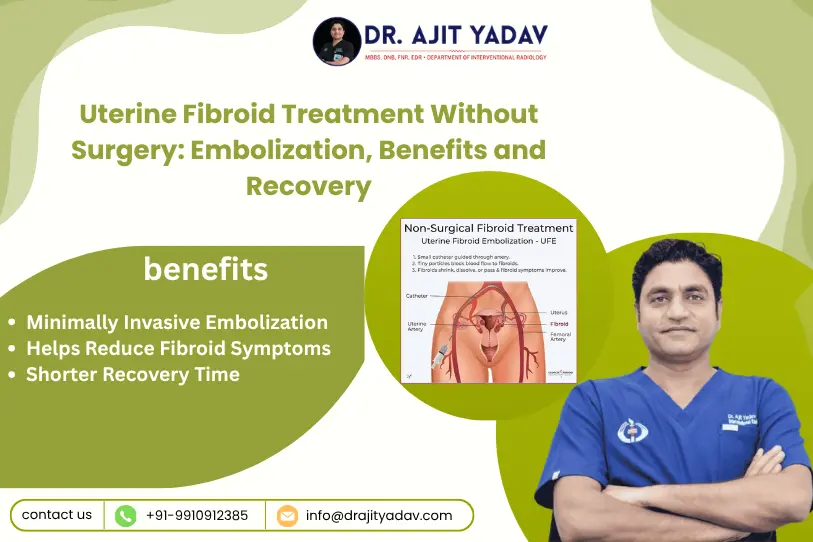
Uterine Fibroid Embolization is a minimally invasive procedure designed to reduce blood flow to uterine fibroids. During the procedure, an interventional radiologist guides a thin catheter through a blood vessel to the arteries supplying the fibroid. Small embolic particles are then delivered to reduce the fibroid’s blood supply.
The reduced blood flow causes the fibroid to shrink gradually. The uterus remains in place, unlike procedures that remove the uterus.
Uterine Fibroid Treatment Without Surgery: Embolization, Benefits and Recovery therefore represents an important treatment pathway for appropriately selected patients who want to explore a minimally invasive approach.
How is the procedure performed?
The procedure generally involves:
- A detailed clinical and imaging assessment.
- Local anesthesia and appropriate medication for comfort.
- Placement of a thin catheter into an artery, commonly through the wrist or groin.
- Imaging guidance to identify the arteries supplying the fibroids.
- Delivery of carefully selected embolic particles.
- Removal of the catheter and monitoring during recovery.
The exact technique and duration can vary according to the patient’s anatomy, fibroid characteristics, and clinical circumstances.
What are the benefits?
Potential benefits of UFE include:
- Minimally invasive treatment
- No large abdominal incision
- Preservation of the uterus
- Reduction in fibroid-related bleeding and pressure symptoms
- Generally shorter recovery than major abdominal surgery
- Treatment of multiple fibroids during the same procedure
- Gradual reduction in fibroid size
However, no procedure is suitable for everyone. The benefits and potential risks should be discussed individually with an experienced specialist.
UFE compared with surgical treatment
Uterine Fibroid Treatment Without Surgery: Embolization, Benefits and Recovery does not mean that surgery is never required. Instead, it highlights an alternative that may be suitable for selected patients.
| Factor | Uterine Fibroid Embolization | Surgical Treatment |
| Approach | Minimally invasive | Surgical |
| Large abdominal incision | Usually not required | May be required depending on procedure |
| Uterus | Preserved | Depends on the surgery |
| Recovery | Generally shorter than major surgery | Varies by procedure |
| Multiple fibroids | Can often be treated together | Depends on surgical approach |
| Suitability | Individual assessment required | Individual assessment required |
The best treatment depends on symptoms, fibroid characteristics, overall health, and reproductive plans. Women who are specifically planning a pregnancy should discuss this goal carefully with their gynecologist and interventional radiologist before choosing treatment.
Recovery, FAQs and Choosing the Right Treatment
What is recovery like after UFE?
Recovery varies from person to person. Some patients experience cramping, pelvic discomfort, fatigue, nausea, or mild fever-like symptoms for a short period following the procedure. These effects can generally be managed with medications prescribed by the treating team.
Many patients gradually return to normal activities over the following days, although the exact recovery period depends on the individual and the nature of the procedure.
Fibroids do not disappear immediately. Their size generally decreases gradually over time, and symptoms may improve progressively.
Is UFE suitable for everyone?
No. Suitability depends on the type, number, size, and location of fibroids, symptoms, medical history, imaging findings, and personal treatment goals. A detailed evaluation is necessary before recommending the procedure.
Women searching for Uterine Fibroid Treatment should avoid choosing a procedure solely on the basis of online information. A specialist assessment is important for selecting an appropriate treatment plan.
Frequently Asked Questions
1. What is the best treatment for uterine fibroids?
There is no single best treatment for every patient. Options may include observation, medication, minimally invasive procedures such as UFE, myomectomy, or hysterectomy. The choice depends on symptoms, fibroid characteristics, health status, and reproductive goals.
2. Can uterine fibroids be treated without surgery?
Yes. Selected patients can be treated using minimally invasive approaches such as Uterine Fibroid Embolization. Whether UFE is appropriate depends on individual clinical and imaging findings.
3. Does Uterine Fibroid Embolization remove the fibroid?
UFE does not physically remove the fibroid. Instead, it reduces its blood supply, which causes the fibroid to shrink gradually.
4. How long does it take for fibroids to shrink after embolization?
Fibroids generally shrink gradually rather than immediately. The amount and rate of shrinkage vary between patients and depend on factors such as fibroid characteristics and response to treatment.
5. Is UFE painful?
Some patients experience pelvic cramping or discomfort after embolization. The treating team can provide appropriate pain-management medication and supportive care.
6. Can multiple fibroids be treated with UFE?
Yes. UFE can often address multiple fibroids during one procedure, although individual suitability must be confirmed through clinical assessment and imaging.
7. Can I become pregnant after UFE?
Pregnancy after UFE is possible for some women, but the effect of treatment on fertility and pregnancy should be discussed individually. Women who strongly wish to become pregnant should have a detailed discussion with their gynecologist and interventional radiologist before treatment.
8. Is UFE better than a hysterectomy?
These procedures have different purposes and outcomes. UFE preserves the uterus, while hysterectomy removes it. The appropriate option depends on the patient’s symptoms, age, medical circumstances, reproductive plans, and preferences.
9. How do I find Uterine Fibroid Treatment near me?
Start by looking for a qualified gynecologist or interventional radiologist with experience in fibroid management. Patients in Delhi can seek an in-person assessment to determine whether minimally invasive treatment is appropriate.
Conclusion
Uterine Fibroid Treatment Without Surgery: Embolization, Benefits and Recovery offers an overview of Uterine Fibroid Embolization as a minimally invasive option for appropriately selected patients. By reducing blood flow to fibroids, UFE can help reduce fibroid size and improve symptoms while preserving the uterus.
However, treatment should always be individualized. Fibroid size, location, symptoms, medical history, reproductive goals, and imaging findings all influence the treatment decision. There is no universal treatment or guaranteed outcome, so professional evaluation is essential.
If you are experiencing heavy menstrual bleeding, pelvic pressure, pain, or other symptoms associated with uterine fibroids, Dr. Ajit Yadav can evaluate your condition and discuss whether Uterine Fibroid Embolization or another treatment option may be appropriate.
Book an appointment with Dr. Ajit Yadav for a personalized evaluation and treatment discussion.
Location: Sir Ganga Ram Hospital, Old Rajinder Nagar, Rajinder Nagar, Delhi – 110060
Phone: 096434 62949
Email: info@drajityadav.com

Comments are closed