
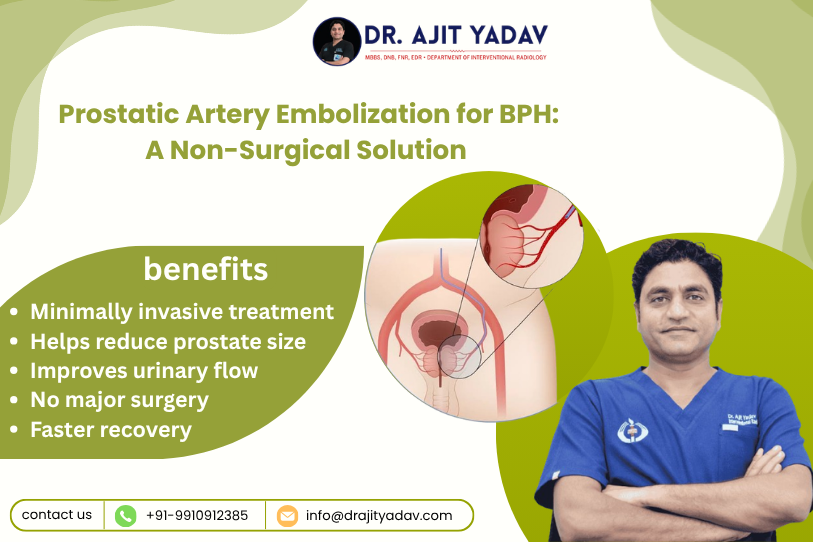
Benign Prostatic Hyperplasia (BPH), commonly known as an enlarged prostate, is a frequent condition in men, particularly with increasing age. An enlarged prostate can press against the urethra and interfere with the normal flow of urine, leading to symptoms such as frequent urination, difficulty starting urination, weak urine flow, and the need to urinate several times during the night.
While medications and conventional prostate procedures can help manage BPH, some patients may be looking for minimally invasive alternatives. Prostatic Artery Embolization for BPH is an image-guided procedure that can reduce blood flow to the enlarged prostate, potentially helping shrink the prostate and improve urinary symptoms.
For patients considering a non-surgical approach, understanding how the procedure works, its potential benefits, suitability, recovery, and limitations can help them make an informed decision with their doctor.
What Is BPH?
Benign Prostatic Hyperplasia is a non-cancerous enlargement of the prostate gland. The prostate is located below the bladder and surrounds part of the urethra, the tube through which urine leaves the body.
As the prostate enlarges, it can narrow the urethra and make it more difficult for urine to pass. Symptoms may develop gradually and can affect daily activities, sleep, and overall quality of life.
Common symptoms of BPH include:
- Frequent urination, especially at night
- Difficulty starting urination
- Weak or interrupted urine stream
- Urgency to urinate
- Feeling that the bladder has not completely emptied
- Dribbling after urination
- Increased frequency of urination
Not every man with an enlarged prostate requires treatment. The appropriate approach depends on symptom severity, prostate size, overall health, medications, and other urinary or prostate conditions.
What Is Prostatic Artery Embolization for BPH?
Prostatic Artery Embolization for BPH is a minimally invasive treatment performed by an experienced interventional radiologist. Instead of surgically removing prostate tissue, the procedure reduces blood flow to selected arteries supplying the prostate.
During the procedure, a thin catheter is carefully guided through a blood vessel, commonly accessed through the wrist or groin. Using real-time imaging, the interventional radiologist identifies the arteries supplying the prostate and delivers tiny embolic particles into the targeted vessels.
By reducing blood supply to the enlarged prostate, the prostate tissue may gradually shrink. This can reduce pressure around the urethra and may improve lower urinary tract symptoms associated with BPH.
The procedure is performed under image guidance and does not involve an incision into the prostate.
Prostatic Artery Embolization for BPH/Enlarged Prostate Explained In Detail
How Does Prostatic Artery Embolization Work?
The basic steps of the procedure generally include:
- Initial evaluation: The patient undergoes a detailed medical assessment, which may include urinary symptom evaluation, blood tests, imaging, and prostate assessment.
- Vascular access: A small puncture is made in a blood vessel, usually in the wrist or groin.
- Catheter navigation: A thin catheter is guided toward the arteries supplying the prostate using X-ray imaging.
- Artery identification: The interventional radiologist carefully maps the prostate’s blood supply.
- Embolization: Small medical particles are delivered into the selected prostatic arteries.
- Completion: Blood flow to the targeted prostate tissue is reduced, and the catheter is removed.
The prostate does not disappear immediately after the procedure. The reduction in prostate volume and improvement in urinary symptoms generally occur progressively over time.
Why Consider Prostatic Artery Embolization for BPH?
One reason some patients consider Prostatic Artery Embolization for BPH is that it provides a minimally invasive alternative to certain surgical treatments for appropriately selected patients.
Potential advantages may include:
- No surgical removal of prostate tissue
- Small vascular access site rather than a large surgical incision
- Generally performed using local anesthesia and/or sedation
- Shorter recovery compared with some traditional surgical procedures
- Potential improvement in urinary symptoms
- May be considered for men with enlarged prostates who are suitable candidates for the procedure
- Can be an option for some patients who cannot or do not want to undergo conventional surgery
However, PAE is not suitable for every patient. A specialist evaluation is important before deciding whether it is an appropriate treatment.
Who May Be a Candidate for PAE?
A urologist and interventional radiologist may consider PAE for men who have bothersome BPH-related urinary symptoms and have not achieved adequate relief with conservative treatment or medications.
PAE may be considered in selected patients with:
- Symptomatic benign prostate enlargement
- Persistent urinary symptoms affecting quality of life
- Prostate enlargement confirmed through appropriate evaluation
- Unsatisfactory response or intolerance to medications
- A preference for a minimally invasive treatment
- Medical conditions that may make conventional surgery less desirable
The decision should be based on an individualized assessment. Prostate cancer, urinary tract problems, bladder dysfunction, or other conditions may require different management.
PAE vs. Traditional BPH Surgery
Traditional procedures such as transurethral resection of the prostate (TURP) physically remove or treat prostate tissue to relieve obstruction. PAE works differently by reducing blood flow to the prostate.
Some important differences include:
| Feature | Prostatic Artery Embolization | Traditional BPH Surgery |
| Approach | Image-guided vascular procedure | Surgical/endoscopic procedure |
| Prostate tissue | Not directly removed | Prostate tissue may be removed or treated |
| Access | Small vascular puncture | Instrument inserted through urinary tract for many procedures |
| Anesthesia | Often local anesthesia with sedation | Depends on procedure |
| Recovery | Generally minimally invasive | Varies by surgical technique |
| Suitability | Depends on prostate anatomy and patient factors | Depends on symptoms and surgical assessment |
Neither treatment is universally better. The appropriate treatment depends on the patient’s prostate anatomy, symptoms, health, treatment goals, and specialist recommendations.
What Are the Benefits of PAE?
The potential benefits of Prostatic Artery Embolization for BPH may include improvement in urinary symptoms and quality of life.
Because PAE is minimally invasive, some patients may experience less disruption to their routine than with certain surgical procedures. It also avoids direct surgical removal of prostate tissue.
Another consideration is sexual function. PAE may have a different sexual side-effect profile from some prostate surgeries, although individual outcomes vary and sexual function should be discussed with the treating specialists.
Patients should understand that PAE has potential risks and may not provide the same outcome for every individual.
Recovery After Prostatic Artery Embolization
Recovery following PAE is generally relatively short, but it varies from person to person.
Some patients may experience temporary symptoms such as:
- Pelvic discomfort
- Mild pain
- Urinary frequency or urgency
- Temporary difficulty with urination
- Fatigue
- Low-grade fever
These symptoms are often temporary, but patients should follow their doctor’s post-procedure instructions and report unusual or persistent symptoms.
Many patients can return to normal activities relatively quickly, depending on their individual recovery and the treating team’s recommendations.
Are There Any Risks or Side Effects?
Although PAE is minimally invasive, it is still a medical procedure and carries potential risks.
Possible complications can include:
- Bleeding or bruising at the catheter entry site
- Infection
- Temporary urinary symptoms
- Pelvic pain or discomfort
- Non-target embolization
- Blood vessel injury
- Incomplete symptom improvement
- Recurrence or worsening of symptoms over time
The risk profile depends on factors such as vascular anatomy, prostate characteristics, medical history, and operator experience.
A detailed consultation with an interventional radiologist can help patients understand the potential benefits and risks in their individual situation.
How Is PAE Different From Medication for BPH?
Medications such as alpha-blockers and 5-alpha-reductase inhibitors are commonly used to manage BPH symptoms. They can be effective for many patients, but they may cause side effects and may not provide adequate relief for everyone.
Prostatic Artery Embolization for BPH offers a procedural treatment option that works by reducing blood flow to the prostate rather than relying on daily medication.
Whether medication, PAE, surgery, or another treatment is appropriate depends on the patient’s symptoms, prostate size, medical history, and treatment preferences.
Why Choose an Experienced Interventional Radiologist?
PAE requires detailed knowledge of pelvic vascular anatomy and advanced image-guided techniques. The prostatic arteries can vary considerably between individuals, making careful identification of the blood supply an important part of the procedure.
Dr. Ajit K. Yadav is a Senior Consultant and Vice-Chairperson in the Department of Interventional Radiology at Sir Ganga Ram Hospital, New Delhi. He completed his medical degree at Pt. B.D. Sharma Post Graduate Institute of Medical Sciences, Rohtak, followed by residency training in radiodiagnosis at Sir Ganga Ram Hospital.
He was nationally board-certified in 2011 and subsequently completed a fellowship in Interventional Radiology at GRIPMER, Delhi.
Dr. Ajit K. Yadav provides minimally invasive, image-guided procedures across several areas of interventional radiology, including treatments related to vascular conditions, liver diseases, and traumatic bleeding.
For patients considering Prostatic Artery Embolization for BPH, an evaluation by an experienced interventional radiologist, alongside appropriate urological assessment, can help determine whether PAE is suitable.
Frequently Asked Questions About Prostatic Artery Embolization for BPH
Is PAE a non-surgical treatment for BPH?
PAE is a minimally invasive, image-guided procedure that does not require surgical removal of prostate tissue. It is therefore considered a non-surgical or minimally invasive treatment option for selected men with BPH.
How long does PAE take?
The procedure duration varies depending on the patient’s vascular anatomy and procedural complexity. Your interventional radiologist can provide a more accurate estimate after evaluating your case.
Does PAE permanently cure BPH?
PAE can provide significant symptom improvement for appropriately selected patients, but it should not be described as a guaranteed permanent cure. Symptoms can recur, and long-term outcomes vary.
Is PAE painful?
Some patients experience pelvic discomfort, pain, urinary urgency, or other temporary symptoms after the procedure. Pain management is provided according to the patient’s needs and the treating team’s protocol.
Is PAE suitable for everyone with an enlarged prostate?
No. PAE is not appropriate for every patient with BPH. A detailed evaluation of symptoms, prostate anatomy, blood vessels, medical history, and other possible causes of urinary symptoms is necessary.
Take the Next Step for BPH Treatment
Living with persistent BPH symptoms can affect sleep, daily activities, and quality of life. If medications are not providing adequate relief or you are exploring minimally invasive treatment options, Prostatic Artery Embolization for BPH may be worth discussing with an experienced specialist.
Dr. Ajit K. Yadav provides image-guided minimally invasive procedures at Sir Ganga Ram Hospital, New Delhi. A specialist consultation can help determine whether PAE is appropriate for your condition and explain the expected benefits, risks, alternatives, and recovery.
Book a consultation to discuss your BPH symptoms and explore suitable treatment options.

Comments are closed