
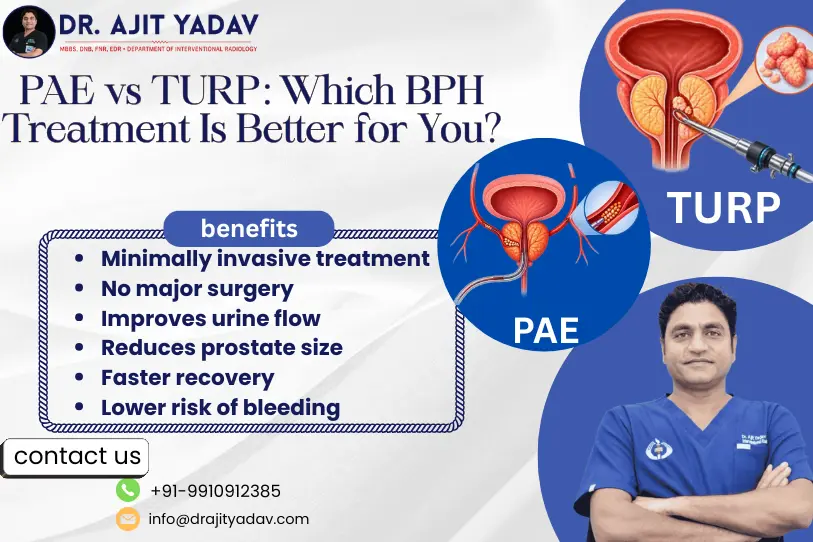
Benign prostatic hyperplasia (BPH), commonly called an enlarged prostate, is a frequent condition in aging men. As the prostate enlarges, it can press against the urethra and interfere with normal urine flow. Symptoms may gradually affect sleep, daily activities, confidence, and quality of life.
When medicines no longer provide adequate relief, men may be advised to consider a procedure. Two options that may come up during consultation are Prostatic Artery Embolization (PAE) and Transurethral Resection of the Prostate (TURP). Although both can improve urinary symptoms, they work in very different ways.
If you are wondering PAE vs TURP: Which BPH Treatment Is Right for You?, the answer depends on your prostate anatomy, symptoms, medical history, treatment goals, and assessment by an appropriately trained specialist.
Importantly, PAE is a minimally invasive treatment performed by an interventional radiologist, while TURP is an endoscopic surgical procedure performed by a urologist. Current evidence and professional guidelines continue to evolve, so treatment should be individualized rather than selected solely on the basis of a comparison table. The American Urological Association (AUA) has included PAE in its educational material while continuing to evaluate evidence surrounding its role in BPH management.
This guide explains PAE vs TURP: Which BPH Treatment Is Right for You?, including symptoms, causes, diagnosis, procedures, benefits, recovery, and important differences between the two approaches.
Understanding BPH: Symptoms, Causes and Diagnosis
Introduction to benign prostatic hyperplasia
The prostate is a gland located below the bladder and surrounding part of the urethra. As men age, the prostate may gradually increase in size. This benign enlargement is different from prostate cancer.
Not every man with an enlarged prostate needs a procedure. Treatment is generally considered when symptoms become bothersome, complications develop, or medicines fail to provide sufficient improvement.
Benign Prostate Hyperplasia (BPH) Symptoms & Treatments
Symptoms of BPH
Common symptoms include:
- Frequent urination, particularly at night
- Difficulty starting urination
- Weak or interrupted urine stream
- Feeling that the bladder has not emptied completely
- Urgency to urinate
- Dribbling after urination
- Increased time needed to pass urine
- Difficulty maintaining a normal urinary stream
- In some cases, urinary retention
Severe or sudden urinary retention requires prompt medical evaluation.
Causes and risk factors
The exact cause of BPH is multifactorial, but ageing and hormonal changes are strongly associated with prostate growth. Family history, metabolic health, and age may also influence risk.
It is important to remember that urinary symptoms do not always mean BPH. Urinary infection, bladder disorders, urethral narrowing, prostatitis, medications, neurological conditions, and prostate cancer can produce overlapping symptoms.
Diagnosis
A proper diagnosis is essential before deciding between PAE and TURP.
A specialist may recommend:
- Medical history and symptom assessment
- International Prostate Symptom Score (IPSS)
- Physical examination
- Digital rectal examination when appropriate
- Urine testing
- PSA testing when clinically indicated
- Ultrasound to assess prostate and bladder
- Measurement of post-void residual urine
- Uroflowmetry to evaluate urine flow
- Additional imaging or cystoscopy in selected patients
The purpose is not simply to determine prostate size. Doctors also need to understand the severity and pattern of obstruction, bladder function, other medical conditions, and the patient’s treatment priorities.
If you are asking PAE vs TURP: Which BPH Treatment Is Right for You?, a personalized evaluation is therefore more useful than choosing a procedure based on age or prostate size alone.
PAE vs TURP: Procedures, Benefits and Recovery
What is Prostatic Artery Embolization?
Prostatic Artery Embolization (PAE) is a minimally invasive, image-guided procedure used to reduce symptoms associated with BPH.
During PAE, an interventional radiologist introduces a thin catheter through an artery, commonly through the wrist or groin depending on the patient’s anatomy and the operator’s approach. Using angiographic imaging, the doctor identifies the arteries supplying the prostate and carefully delivers tiny embolic particles to reduce blood flow to selected portions of the enlarged prostate.
Over time, reduced blood supply can cause the treated prostate tissue to shrink, helping relieve pressure on the urethra and improving urinary symptoms.
PAE does not involve cutting or removing prostate tissue through the urethra. It is therefore fundamentally different from TURP.
Benefits of PAE
Potential advantages may include:
- Minimally invasive treatment
- No removal of prostate tissue through the urethra
- Usually performed with local anaesthesia and sedation rather than general anaesthesia
- Shorter initial recovery for many patients
- Potentially useful for selected patients who are poor candidates for conventional surgery
- May be considered when preservation of ejaculation is an important treatment goal
- No surgical incision in the prostate
However, PAE is not risk-free. Possible complications include pelvic discomfort, temporary urinary symptoms, infection, bleeding at the access site, non-target embolization, and incomplete symptom improvement. Patient selection and operator expertise are important.
What is TURP?
TURP stands for Transurethral Resection of the Prostate. It is a well-established surgical treatment for BPH.
During TURP, a urologist passes a specialized instrument through the urethra and removes prostate tissue that is obstructing urine flow. The removed tissue creates a wider channel for urine to pass from the bladder.
TURP has a long history of use and can provide substantial improvement in urinary obstruction and symptoms. However, it is a surgical procedure and may involve catheterization, bleeding, infection, electrolyte disturbances, and other perioperative risks.
PAE vs TURP: Which BPH Treatment Is Right for You?
The choice should be based on a comprehensive assessment rather than assuming one procedure is universally better.
| Factor | PAE | TURP |
| Type of treatment | Minimally invasive, image-guided | Endoscopic surgery |
| Specialist | Interventional radiologist | Urologist |
| Access | Arterial catheter | Through the urethra |
| Prostate tissue | Not surgically removed | Obstructing tissue is resected |
| Anaesthesia | Often local anaesthesia with sedation | Usually spinal or general anaesthesia |
| Hospital stay | Often short, depending on patient | May require hospital observation |
| Catheter | May be required temporarily | Commonly required after surgery |
| Recovery | Generally shorter for many patients | Usually longer than PAE |
| Bleeding considerations | Generally limited at the prostate | Surgical bleeding is possible |
| Ejaculatory effects | May have a lower risk in selected patients | Retrograde ejaculation is common after TURP |
| Long-term evidence | Growing evidence base | Long-established surgical evidence |
The comparison should not be interpreted as a guarantee of outcomes. Individual results vary.
Recovery after PAE
Many patients can return to light daily activities relatively quickly following PAE, although the exact recovery period varies.
Temporary symptoms can include:
- Pelvic discomfort
- Increased urinary frequency
- Burning while urinating
- Mild fatigue
- Temporary worsening of urinary symptoms
Your doctor will provide specific instructions regarding medications, hydration, activity, and follow-up.
Recovery after TURP
Recovery after TURP usually involves a period of catheterization and monitoring. Some men experience urinary frequency, urgency, or mild burning temporarily after the catheter is removed.
Strenuous activity and heavy lifting are generally restricted during the early recovery period. The exact recovery timeline depends on the patient’s health, surgical technique, prostate characteristics, and postoperative course.
For men comparing PAE vs TURP: Which BPH Treatment Is Right for You?, recovery expectations are an important part of the decision—not simply the procedure itself.
Choosing the Right BPH Treatment
Who may be considered for PAE?
PAE may be considered for selected men with symptomatic BPH, particularly when they want a minimally invasive approach or have medical factors that make conventional surgery less attractive.
A detailed evaluation may consider:
- Severity of urinary symptoms
- Prostate volume and anatomy
- Urinary flow
- Residual urine
- Previous BPH treatments
- Blood-thinning medications
- Cardiovascular and other medical conditions
- Sexual and ejaculatory priorities
- Arterial anatomy
PAE requires specialized expertise because prostate arteries can have complex anatomy and may have branches supplying nearby structures.
Who may benefit from TURP?
TURP remains an established option for men with bothersome or obstructive BPH when surgical treatment is appropriate. It may be particularly suitable when direct removal of obstructing tissue is desired or when the patient’s anatomy and clinical circumstances favor an endoscopic procedure.
The choice should be made jointly with the appropriate specialists.
Is PAE a non-surgical BPH treatment?
PAE is commonly described as a Non-Surgical BPH Treatment because it does not involve surgically cutting or removing prostate tissue. However, it is still an invasive medical procedure involving arterial catheterization and embolization.
Therefore, “non-surgical” does not mean “risk-free” or “no procedure.”
About Dr. Ajit Yadav
Dr. Ajit Yadav is a consultant in the Department of Interventional Radiology at Sir Ganga Ram Hospital, New Delhi. His qualifications include MBBS, DNB, FVIR and EBIR. His professional profile states that his clinical interests include prostatic artery embolization for BPH, uterine artery embolization, oncological interventions, thyroid nodule ablation, bronchial artery embolization and lymphatic interventions.
His interventional radiology services include:
- Prostatic Artery Embolization for BPH
- Uterine Artery Embolization
- Varicocele Embolization
- Thyroid Nodule Ablation
- Liver Tumor Interventions
- TACE and TARE
- Tumor Ablation
- Bronchial Artery Embolization
- Lymphatic Interventions
- Musculoskeletal and pain interventions
- Selected vascular and minimally invasive procedures
Dr Ajit Yadav specifically provides information about PAE for BPH and describes the procedure as a minimally invasive treatment for lower urinary tract symptoms related to an enlarged prostate.
Why specialist evaluation matters
A patient should not choose PAE simply because it is marketed as “non-surgical,” nor should TURP automatically be considered the best option because it is well established.
The AUA’s published guidance has recognized that evidence regarding PAE has evolved, and its educational material discusses PAE in relation to indications, outcomes, durability, efficacy, complications, and comparison with other BPH procedures.
This makes individualized consultation particularly important.
FAQs About PAE vs TURP
1. Is PAE better than TURP for BPH?
Neither procedure is universally better. PAE and TURP use different techniques and have different advantages, limitations, and risk profiles. The right option depends on the patient’s symptoms, prostate anatomy, health, and treatment goals.
2. Is Prostatic Artery Embolization painful?
PAE is generally performed with local anaesthesia and sedation. Some patients experience temporary pelvic discomfort, urinary irritation, or mild pain after the procedure. The severity varies between individuals.
3. How long does it take to recover from PAE?
Recovery varies, but many patients can resume light activities relatively quickly. Your interventional radiologist will provide individualized instructions based on your procedure and medical condition.
4. Does PAE reduce prostate size?
PAE reduces blood supply to targeted prostate tissue, which can result in tissue shrinkage over time and improvement in urinary symptoms. The degree of reduction varies between patients.
5. Does TURP permanently cure BPH?
TURP removes obstructing prostate tissue and can provide durable symptom relief, but prostate tissue can continue to grow with age. Long-term outcomes therefore vary.
6. Can PAE affect sexual function?
One reason some patients consider PAE is the potential to preserve sexual and ejaculatory function. However, sexual outcomes vary, and no procedure should be described as completely free of sexual side effects.
7. Is PAE suitable for an elderly patient?
Age alone does not determine eligibility. PAE may be considered in selected older or medically complex patients, but a detailed assessment is necessary before treatment.
8. Is PAE an alternative to prostate surgery?
For selected patients, PAE can be an alternative minimally invasive treatment for symptomatic BPH. However, it should be discussed with an appropriately trained interventional radiologist and urologist when appropriate.
9. How do I decide between PAE and TURP?
Start with a proper BPH evaluation. Discuss prostate size and anatomy, urinary obstruction, medications, medical conditions, sexual priorities, expected recovery, and the potential risks and benefits of each option.
10. Where can I get expert advice about PAE?
Patients considering PAE can consult an experienced interventional radiologist such as Dr. Ajit Yadav for an individualized assessment and discussion of whether PAE is appropriate.
Conclusion
If you are searching for PAE vs TURP: Which BPH Treatment Is Right for You?, there is no single answer that applies to every man. TURP is a well-established surgical procedure that removes obstructing prostate tissue, while Prostatic Artery Embolization is a minimally invasive, image-guided procedure that reduces blood flow to the prostate to improve BPH-related symptoms.
For some patients, the minimally invasive nature of PAE and its recovery profile may be attractive. For others, TURP or another BPH procedure may be more appropriate. The decision should be based on objective testing, prostate anatomy, overall health, symptom severity, and personal treatment priorities.
PAE vs TURP: Which BPH Treatment Is Right for You? should ultimately be answered after a specialist consultation—not by comparing procedures online alone.
If you have troublesome BPH symptoms, recurrent urinary problems, or are considering an alternative to conventional prostate surgery, book an appointment with Dr. Ajit Yadav for a personalized evaluation and discussion of available minimally invasive treatment options.

Comments are closed